What it is, when to use it, and the core steps involved:
Framework Analysis is a systematic, transparent approach to qualitative data analysis. It was developed for applied policy research. This method is designed to cope with large volumes of interview/focus-group data. It also maintains a clear audit trail from raw data → themes → interpretations.
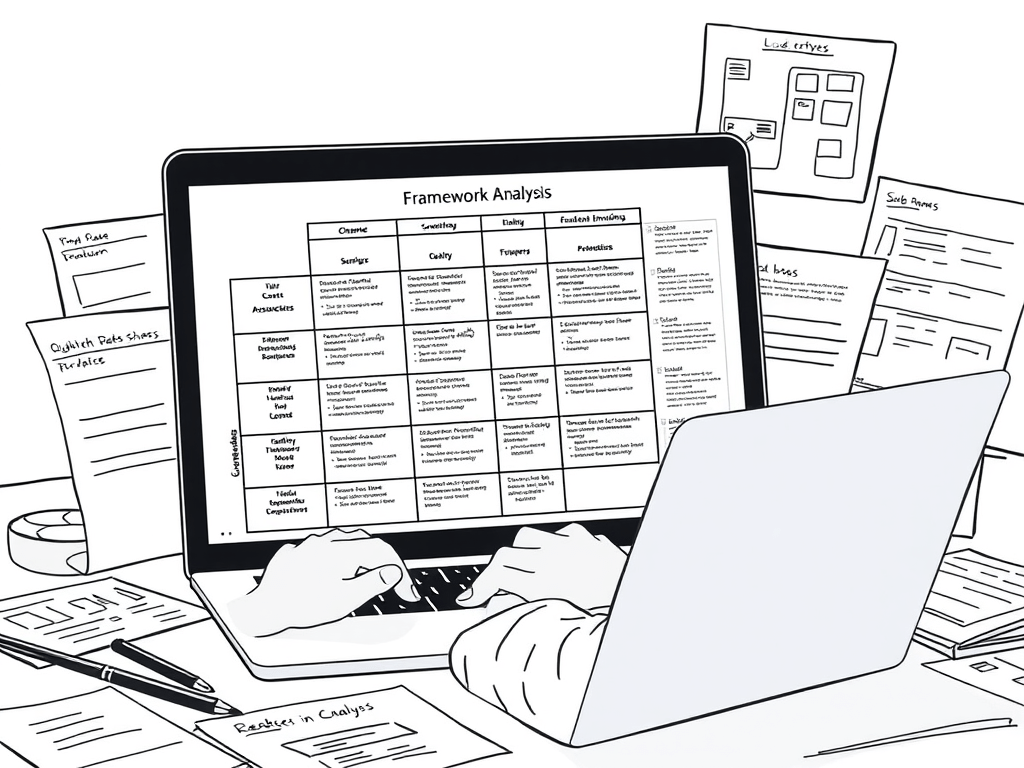
A defining feature is its matrix-based “charting”: data are organised so you can compare within cases (one participant across themes) and between cases (many participants on the same theme), supporting outputs like mapping, typologies, and explanations that are especially useful for policy/practice recommendation
Ritchie & Spencer describe five linked stages:
- Familiarisation – immersing in transcripts/notes to get an overview of key ideas and the range of perspectives.
- Identifying a thematic framework – developing an initial analytic framework with themes and subthemes. This is shaped by study aims and what’s emerging in the data.
- Indexing – applying the framework systematically to the data (i.e., coding).
- Charting – summarising “lifted” data into theme-by-case charts (matrices), emphasising abstraction and synthesis (not just cut-and-paste).
- Mapping & interpretation – using the charts to define concepts, map ranges, build typologies, identify associations, and generate explanations/strategies.
Resources
Ritchie, J., & Spencer, L. (2002). Qualitative data analysis for applied policy research. In Analyzing qualitative data (pp. 173-194). Routledge.
Gale, N. K., Heath, G., Cameron, E., Rashid, S., & Redwood, S. (2013). Using the framework method for the analysis of qualitative data in multi-disciplinary health research. BMC medical research methodology, 13(1), 117.
Goldsmith, L. J. (2021). Using framework analysis in applied qualitative research. Qualitative report, 26(6).
 Nursing Education Network
Leave a Reply