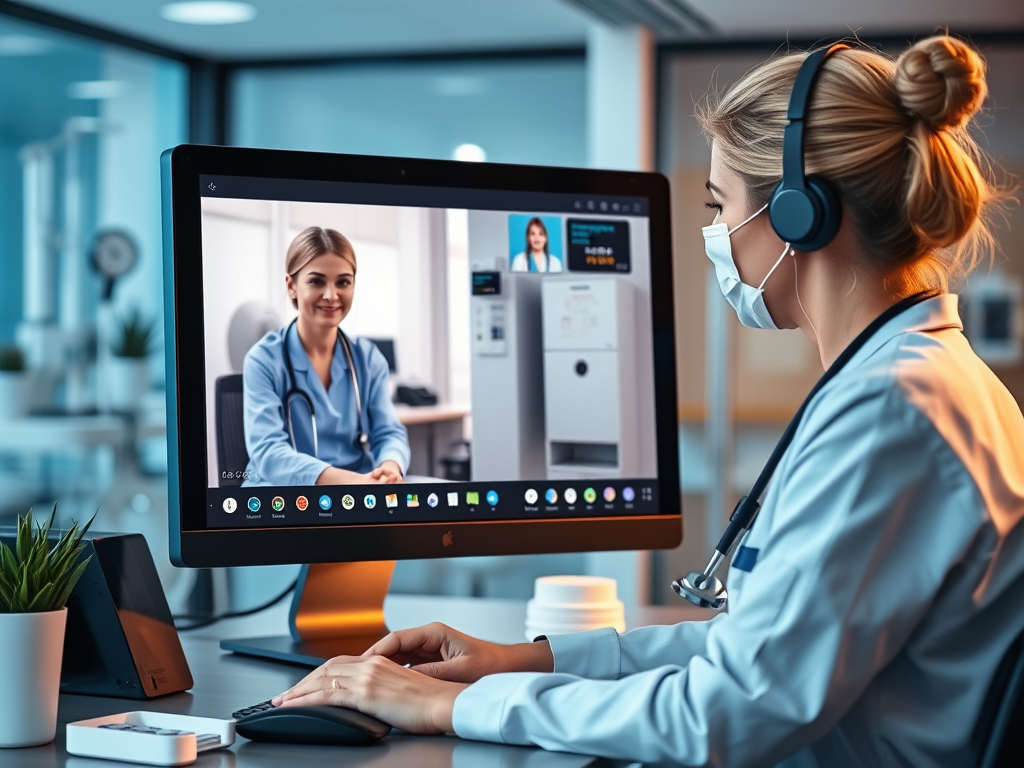
Journal Club Article
Khairat, S., & Clipper, B. (2025). Virtual Nursing and the Future of Workforce Sustainability. JAMA Network Open, 8(12), e2545603-e2545603.
Summary
Nursing workforce shortages are no longer a looming threat—they’re commonly becoming a daily operational reality. Health systems across the US (and many other countries) are grappling with burnout, turnover, and an ageing nursing workforce. These challenges were accelerated during and after COVID-19. As a result, there are fewer registered nurses at the bedside. Meanwhile, demand for care continues to rise.
Against that backdrop, virtual nursing has emerged as a workforce strategy. This model is telehealth-enabled. Nurses provide care remotely through communication, monitoring, and collaboration with in-person teams. It’s often pitched as a way to protect bedside time, standardise key processes, and maintain quality when staffing is tight/short.
But the question that matters most for workforce sustainability is simple: does virtual nursing actually help bedside nurses?
Whether virtual nursing reduces burnout and improves retention, whether it truly fills workforce gaps (versus redistributing tasks), and whether outcome gains outweigh technology and staffing costs—these will determine its value.
Nursing metrics could include:
- Workforce: turnover, sick leave, retention, perceived workload, burnout risk (bedside and virtual)
- Quality & safety: discharge quality, escalation response, adverse event rates, patient education comprehension
- Flow: length of stay, readmissions, delays in discharge processes
- Economics: cost of staffing + technology vs measurable gains in efficiency and outcomes
Bottom line: virtual nursing is a workforce strategy—but only with thoughtful design. Workforce sustainability means not shifting burnout to a new place.
A crucial workforce point: if we design virtual nursing badly, we may simply relocate strain from bedside nurses to virtual nurses. Virtual nursing is not a staffing substitute. It’s a care-delivery model that must be integrated into baseline safe staffing and redesigned workflows.
Resources
American Nurses Association. (2025). Principles of virtual nursing.
Khairat SM, MorelliJ, Qin Q,etal. (2025). Effect of virtual nursing implementation on emergency department efficiency and quality of care. AmJEmergMed. 91:59-66.
Muir JK, Maye A, McHugh MD, Aiken LH, Vo V, Lasater KB. (2025). Virtual nursing for the care of hospitalized patients. JAMA Netw Open. 8(12):e2545597.
 Nursing Education Network
Leave a Reply